What Is API 650, and Why Should You Care Before Buying a Storage Tank in Lahore?
If you’ve been quoted for a storage tank and seen “API 650” mentioned, if you are searching for certification for API 650 storage tank Lahore, you might be wondering whether it’s a meaningful standard or just a phrase suppliers add to sound credible. It’s a real, specific standard — and knowing what it actually requires is the fastest way to tell a genuine tank manufacturer from a general welding shop in Lahore.
What Is API 650?
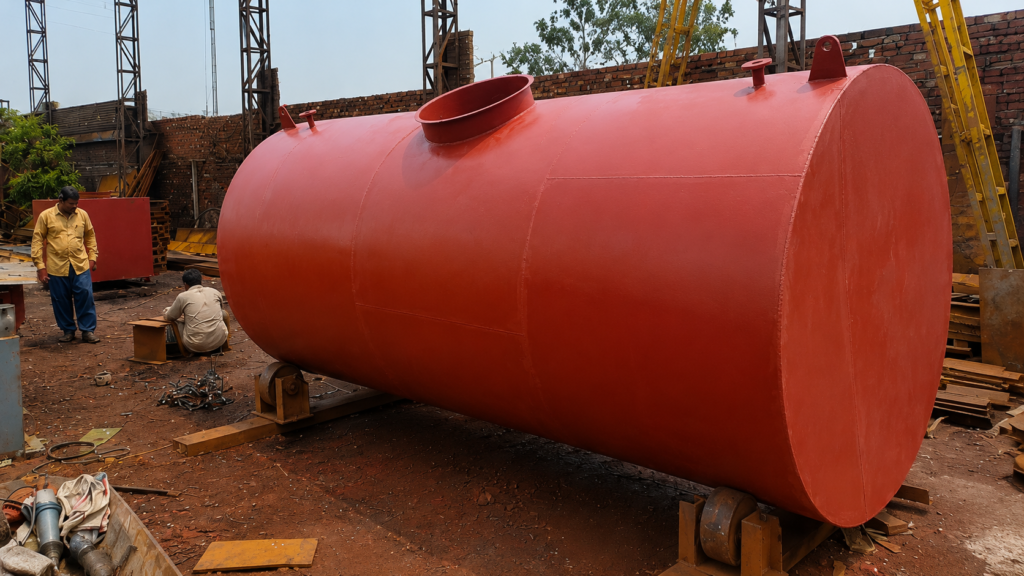
API 650 is a standard published by the American Petroleum Institute that governs the design, fabrication, erection, and inspection of welded steel tanks for oil storage — and, by extension, is widely applied to atmospheric storage tanks for diesel, water, chemicals, and other liquids across the industry.
In plain terms, it defines:
- Minimum plate thickness based on tank diameter, height, and the liquid’s specific gravity
- Foundation and shell design requirements
- Welding procedures and qualification requirements for welders
- Mandatory inspection and testing methods before the tank enters service
A tank “built to API 650” isn’t a marketing phrase — it means the design was calculated against these engineering rules, not estimated by eye.
API 650 vs. ASME Section VIII — What’s the Difference?
These two standards get confused often, but they cover different things:
| Standard | Applies To | Typical Use |
|---|---|---|
| API 650 | Atmospheric (low-pressure) storage tanks | Diesel, fuel, crude oil, water storage |
| ASME Section VIII | Pressure vessels | Compressed gas, process vessels, pressurized chemical storage |
If your application is simple atmospheric liquid storage (most diesel, water, and chemical tanks), API 650 is the relevant standard. If your process involves pressurized storage, you need ASME Section VIII compliance instead — and a competent fabricator should be able to tell you which one your application actually requires, rather than quoting whichever sounds more impressive.
Why This Matters for Your Specific Tank
1. Safety. An underdesigned fuel tank shell can bulge, crack, or fail at the weld seams under hydrostatic load — especially as the tank ages. API 650’s shell-thickness calculations exist specifically to prevent this.
2. Regulatory compliance. In Pakistan, petrol station and fuel depot tanks typically need to satisfy OGRA requirements for licensing. An uncertified tank can hold up your license application or fail an inspection outright.
3. Insurance and financing. Banks and insurers increasingly ask for tank certification documents (MTRs, hydro-test certificates) before approving industrial financing or coverage. Without documentation, you may not be able to claim on a policy after a failure.
4. Long-term cost. A properly designed, tested, and lined tank is engineered for a 25+ year service life. An uncertified tank may need replacement or major repair within a fraction of that time — making the “cheaper” option far more expensive over its real lifespan.
How to Verify a Fabricator Actually Meets API 650 (Not Just Claims To)
Ask these four questions before signing a contract:
- “Can I see your Weld Procedure Specification (WPS) and Procedure Qualification Record (PQR)?” These documents prove the welding process has been formally qualified — not just performed by an experienced-looking welder.
- “Are your welders qualified to AWS D1.1 or ASME Section IX?” These are the welder-qualification standards referenced by API 650. A fabricator should be able to name them without hesitation.
- “What testing happens before the tank ships — hydrostatic, UT, RT?” Hydrostatic testing checks for leaks under water pressure. Ultrasonic (UT) and radiographic (RT) testing inspect weld integrity that’s invisible to the eye.
- “Will I receive a Mill Test Report for the steel used?” This confirms the actual chemical and mechanical properties of the plate — not just that “certified steel” was used, but proof of which grade.
PRO version.
If a fabricator can’t answer these clearly and without prompting, the “API 650” label on their quote is doing more marketing work than engineering work.
What This Looks Like at Mech-Civ Construction Services
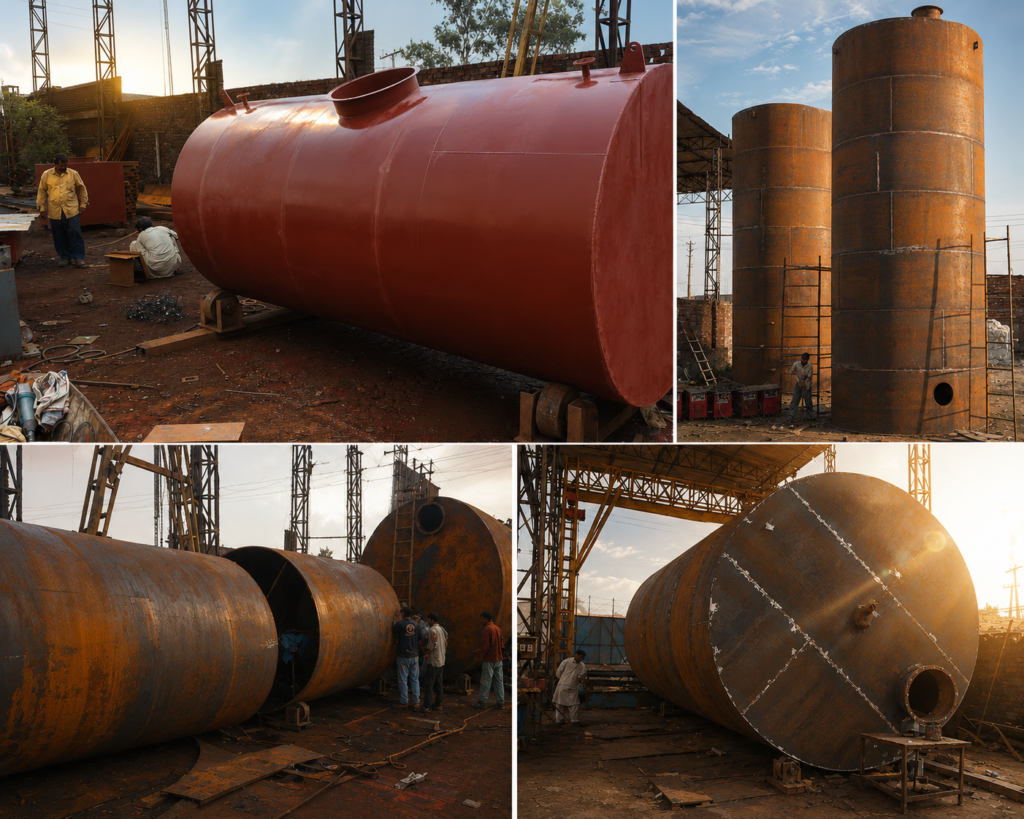
MCCS fabricates storage tanks to API 650 and ASME Section VIII standards, with welders qualified to AWS D1.1 and ASME Section IX. Every tank undergoes hydrostatic pressure testing, UT/RT inspection, and vacuum-box seam testing before delivery, and buyers receive the full documentation package as standard: Mill Test Reports, weld maps, NDT reports, hydro-test certificates, WPS/PQR records, and as-built drawings.
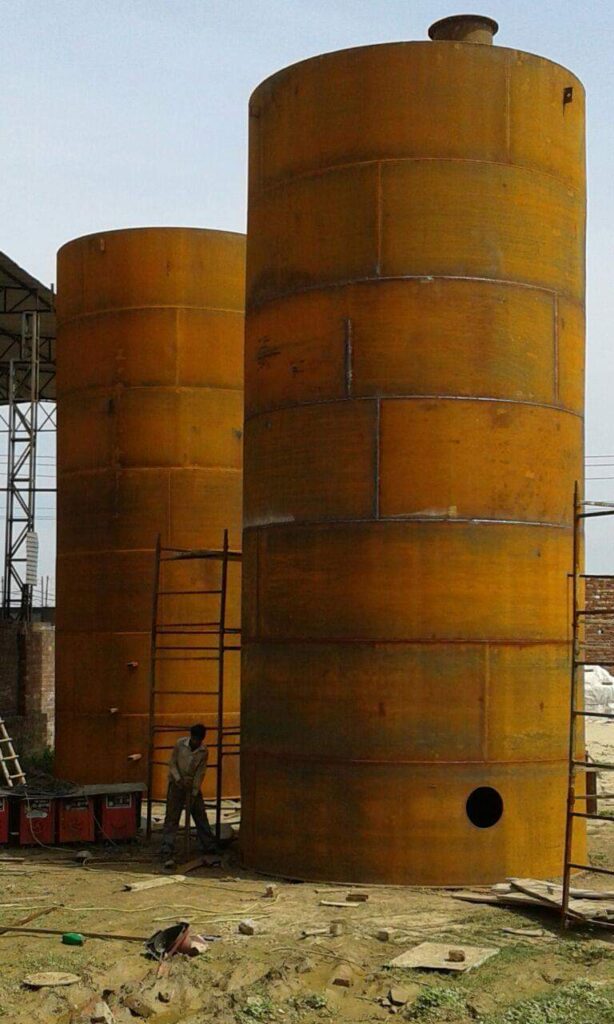
The fabrication workshop is based in DHA Cantt, Lahore, and is open for inspection — you’re welcome to see the process before committing to an order. Full specifications for each tank type (diesel, water, chemical, food-grade, underground) are listed on the storage tanks page.
📞 Speak directly with an engineer: 0321-8771689 (call or WhatsApp)
Frequently Asked Questions
Q: What does API 650 mean for a storage tank? A: API 650 is an American Petroleum Institute standard governing the design, fabrication, and inspection of welded atmospheric steel storage tanks — commonly used for diesel, fuel, crude oil, and water storage. It sets minimum requirements for plate thickness, welding qualification, and mandatory testing before a tank enters service.
Q: Is API 650 the same as ASME Section VIII? A: No. API 650 covers atmospheric (low-pressure) storage tanks, while ASME Section VIII covers pressure vessels used for compressed gas or pressurized chemical processes. The correct standard depends on whether your tank operates at atmospheric pressure or under pressure.
Q: How can I verify a tank manufacturer in Lahore actually follows API 650? A: Ask for their Weld Procedure Specification (WPS), Procedure Qualification Record (PQR), welder qualifications (AWS D1.1/ASME IX), details of hydrostatic and NDT testing performed, and a Mill Test Report for the steel used. A genuine API 650 fabricator provides all of these without hesitation.
Q: Why does storage tank certification matter if the tank looks the same either way? A: Certification isn’t visible from the outside — it reflects engineering calculations, weld quality, and testing that determine whether the tank will hold up safely over a 25+ year service life. Uncertified tanks carry a higher risk of leaks, corrosion failure, and regulatory rejection, particularly for fuel and chemical storage.
MECH-CIV (Peb, Pre-Engineered Buildings, Peb Manufacturing)
Address: Suit# 2 Second Floor, Khursheed Plaza, D.H.A. Main Blvd, Dha Phase 2 Cantt, Lahore, 54000
Phone: 0321 8771689
| Saturday | Open 24 hours |
| Sunday | Open 24 hours |
| Monday | Open 24 hours |
| Tuesday | Open 24 hours |
| Wednesday | Open 24 hours |
| Thursday | Open 24 hours |
| Friday | Open 24 hours |